

How To Add Image Columns To Amazon Advanced Template
New charts, formatting, and layout options in Amazon QuickSight
Amazon QuickSight is a fast, cloud-powered business intelligence (BI) service that makes it easy to create and deliver insights to everyone in your organisation. In this post, we explore how authors of QuickSight dashboards can employ some of the new chart types, layout options, and dashboard formatting controls to deliver dashboards that intuitively deliver insights to all your users, whether within QuickSight or embedded in your websites or multi-tenant apps.
This weblog postal service explores some of the visualization and dashboard customization features offered in Amazon QuickSight with the following datasets:
- Ads dataset for stacked area and funnel charts
- P&L dataset for waterfall charts
- Student Functioning dataset for histograms and box plots
- Patient Info dataset for filled/choropleth maps
Picking the right chart for your use case
In this department, nosotros explore some of the new charts QuickSight introduced in 2020 and how these assistance with various use cases.
Funnel charts
Funnel charts assist visualize the progressive reduction of data as information technology passes from i stage to another. Data in each of these phases is represented equally different portions of 100% (the whole). The most mutual use of the funnel chart is in visualizing conversion data. For case, you can represent sales lead generation showing unlike stages of sales conversion from first contact to pb generation.
To build a funnel nautical chart with our Ads dataset, complete the following steps:
- On the analysis folio, choose Visualize.
- Cull Add, then cull Add visual.
- In the Visual types pane, choose the funnel nautical chart icon.
- For Group by, choose Stage.
- For Value, choose Advertisement proper name.
- To change default configuration, choose the gearicon.
- In the Data labels section, for Metric label style, choose Value and percent of first.

The video below demonstrates these steps.
Stacked area charts
Stacked surface area charts are best used to visualize office-to-whole relationships, to prove how each category contributes to the cumulative total. For this post, we create a stacked expanse nautical chart with the Ads dataset.
- On the analysis page, choose Visualize.
- Choose Add, then cull Add visual.
- In the Visual types pane, choose the stacked surface area charticon.
- For Ten axis, cull Date (MONTH).
- For Value, choose Cost (Sum).
- For Color, choose Segment.
- Choose the gearicon.
- Under Legend, deselect Legend title.
- Under Y-Centrality, select Testify Y centrality label.
- Nether Data labels, select Bear witness data labels.
- Cull your desired position, font size, font colour, and label pattern.

Histograms
Histograms assistance visualize the frequency distribution of a dataset and display numerical information by grouping data into bins of equal width. Each bin is plotted as a bar whose superlative corresponds to the number of data points within the bin.
For this post, we utilize the Educatee Performance dataset to create a histogram.
- On the analysis page, choose Visualize.
- Choose Add, then choose Add visual.
- In the Visual types pane, cull the histogramicon.
- For Value, choose math score.
You can customize the histogram to bear witness bins past bin count, bin width, or a custom showtime value. For this mail service, we sort past bin width.
- Under Histogram, select Bin width.
- For Bin width, enter 5.

Box plots
Box plot (too called box orwhisker plot) is a standardized way of displaying distribution of information based on a five-number summary (minimum, first quartile (Q1), median, third quartile (Q3), and maximum). This is useful to make up one's mind if data is symmetrical, skewed, or tightly grouped. Box plots also show outliers.
For this mail service, we create a box plot on the Student Functioning dataset.
- On the assay page, choose Visualize.
- Choose Add, then choose Add visual.
- In the Visual types pane, choose the box ploticon.
- For Group past, choose Gender.
- For Value, choose writing score and reading score.
- In the visual settings, under Box plot, select Show outliers and Show all data points.
- Under Legend, deselect Show legend title.

Waterfall charts
Waterfall charts help you understand the cumulative event of sequentially introduced positive or negative values. This is neat to sympathize contributions to a whole, for example the master contributors to a monthly increase in revenue, or the breakdown of revenue vs costs.
Nosotros use the P&50 dataset to create a waterfall chart.
- On the analysis folio, choose Visualize.
- Choose Add, then cull Add visual.
- In the Visual pick pane, choose the waterfall charticon.
- For Category, choose Line item.
- For Value¸ choose Value (Sum).
- Under Legend, deselect Show fable title.
- For Position, select Lesser.
- Nether Title, deselect Prove championship.

Choropleth maps
Choropleth maps utilize differences in shading or coloring within geographical areas or regions to indicate the value of a variable in those areas
We use the Patient Info dataset to create a choropleth map.
- On the analysis page, choose Visualize.
- Choose Add, then choose Add visual.
- In the Visual types pane, cull the funnel charticon.
- For Location, choose State.
- For Color, choose Acquirement (Sum).
- Choose the menu options icon (…) and choose Conditional formatting.
- For Column, cull Revenue.
- For Fill up type, select Gradient.
- For Max value, choose a color (for this postal service, we choose blue).

The video below demonstrates these steps.
You can also control the color and shading of the geographic areas using conditional formatting as shown below.

The video beneath demonstrates these steps.
Additionally, you can configure the alignment of column headers and content within. You tin modify the vertical alignment – top, centre, lesser and also the horizontal alignment – left, center and correct.

Customization and formatting options
QuickSight as well supports several formatting options that let you to streamline visualizations and convey additional information in your dashboards.
Table/pivot table formatting
Pivot or unpin and add custom text totals
You can now pin totals to the summit or bottom of tables and pivot tables in QuickSight. This feature helps you view the totals fifty-fifty while scrolling through the tables.
- Get to visual setting (gear icon on the visual menu).
- Under Full, select Pin totals.
- For Position, choose a position (for this post, we cull Bottom).
Additionally, you can edit the text you want to show on totals and subtotals.
- For Total label, enter your custom text (for this mail service, we enter
Grand Total).

Tabular array alignment and wrapping
You lot can at present align horizontal (left, right, center, car) and vertical (height, centre, bottom) alignment on cavalcade headers and prison cell values in a tabular array visual. Additionally, you tin can utilise text wrapping on table and pivot table headers and so that long headers are readable versus having to scroll over the header.
These options are available nether Table options.

Hide +/- buttons on pivot tables
You lot can now evidence or hide +/- buttons on pivot tables. This allows yous to amend presentation of pin tables by removing these icons and keeping the pivot table simple. This pick is available under Styling.

Visual customization options
In this section, we discuss additional customization options in QuickSight.
Custom sorting
If you want to sort your charts in a custom defined order different from the default alphabetic order, you can now do so on QuickSight. For case, you lot can sort geographical regions in the order of East, West, Central, and South, past ranking these regions one– 4 and then sorting on this rank field. Encounter video below to learn how to.
You can likewise therefore sort using any other critical metric fields that aren't role of the visual. Choose your field well and choose Sort options to run into available sort order options.
You lot can as well therefore sort on any other critical metric fields that aren't part of the visual. Choose your field well and choose Sort options to see available sort order options.

The following screenshot shows your sorted visualizations.

Adding descriptive text, images, and links
You lot can add images or logos to your dashboard using QuickSight'due south narrative component available in Enterprise Edition.
- On the analysis page, cull Visualize.
- Choose Add, then cull Add visual.
- In the Visual types pane, choose the insightsicon.
- Choose Customize insight.
- Remove whatever existing text and add your custom text.
You tin also add hyperlinks to text and images. Upload your prototype to a secure location where the prototype is accessible to QuickSight and your users.

The video beneath demonstrates these steps.
Customizing colors and fonts
QuickSight offers like shooting fish in a barrel-to-build themes that permit customization of the color palette, background and foreground colors, spacing, fonts, and more. Themes can be created past authors and shared within an account, and are also accessible via APIs for programmatic management. Themes can also be defaulted for all users in the arrangement using APIs.

You tin can also prioritize the colors that you desire to apply in your dashboard by prioritizing them within your theme's color palette.

You tin can utilise predefined themes available out of the box or create your own themes that fit your corporate branding. The following screenshots evidence how a dashboard looks in both dark and light themes.


For more data, see Evolve your analytics with Amazon QuickSight'due south new APIs and theming capabilities.
Null value customization
Y'all may occasionally have cipher values in your information and want to represent nulls with dissimilar annotations. For each of the dimensions and metrics in the dataset, you tin provide custom text for nil values. Become to More formatting options for whatever field.

The option is available under Null values.

Reference lines
You lot can draw reference lines based on a calculated field or a constant value. Choose the gear icon and navigate to reference lines section. In the following screenshot, the orange reference line is based off a calculation (average profit) and the black reference line is plotted on a constant value of 1,000.

You can as well link reference lines to parameters via a calculated field, which allows you to create what-if scenarios within your dashboard.
Custom colors on heat and tree maps
Color slope customization on oestrus and tree maps allows yous to select colors for lower, intermediate, and upper limits and so that the gradient is applied within these colors. You can configure this under Color in the visual settings.

Using logarithmic scale
If your metric numbers aren't in the same social club of magnitude, where some are extremely on the college end and others on the lower terminate (for example, representing stock price for unlike entities or pandemic spread rates), you can stand for them on a logarithmic calibration so they're normalized, yet relative. To utilize logarithmic scale, go to visual setting and under Y-Centrality, for Scale, select Logarithmic.

The following screenshot shows your visualization after applying logarithmic scale.

Adaptable font size
Y'all tin now apply different font sizes on all visual content and visuals titles. In pivot tables and tables, you can run into font sizes for table headers, cells, totals, and subtotals. In key performance indicators (KPIs), y'all can set font sizes for primary and comparing values, which allows you to go on dashboards dumbo and add more KPIs.

Actions
Finally, to all these charts, you can apply the following actions:
- Filter actions– Select points on a nautical chart to filter across the dashboard. QuickSight supports hierarchical filter actions that permit you to trigger 1 filter activity from more one nautical chart. For more than information, see Enhancing dashboard interactivity with Amazon QuickSight Actions.
- URL actions – Trigger navigation from the dashboard to an external website and laissez passer dynamic values within a URL.

Layout enhancements
QuickSight dashboards default to auto-fit mode, which makes them responsive based on screen size. Nonetheless, in many situations, it's preferable that the view you design is exactly what end-users see, whether on a laptop or a big monitor. QuickSight offers optimized layouts that let y'all to pick a specific screen resolution to optimize for (such as the screen size most of your users utilise on a daily basis), and QuickSight automatically scales the dashboard view to return accordingly on larger or smaller screens. This doesn't touch on mobile devices—QuickSight automatically optimizes for mobile devices using a single-column layout. To adjust the scaling mode, cull Settings in the navigation pane while in dashboard authoring (assay) fashion.
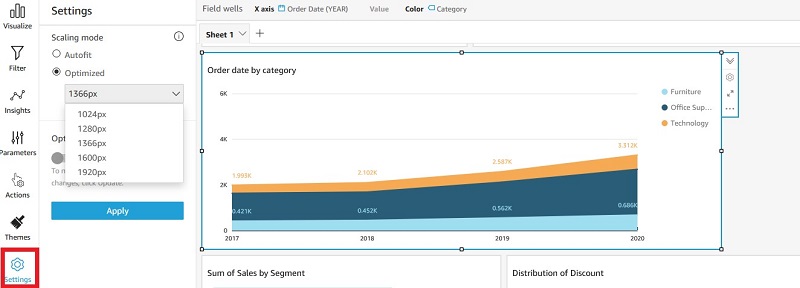
If you build your dashboard for a 1024 px screen, for instance, QuickSight scales that view to a larger or smaller screen to ensure that all users encounter the same content (mobile devices proceed to fall back to a unmarried-column, mobile-specific layout to ensure usability). Opting for the optimized mode as well makes sure that your email reports look exactly like the dashboard that your viewers interact with.
On-sheet filter controls
You can now add filters to your dashboard direct without having to create parameters. Choose the field that you need to filter on cull Add filter for this field. Choose the newly added filter and choose Add to sheet.

If you need to pivot information technology to the controls section, choose the filter and choose Pin to top.

The video below demonstrates these steps.
Thus, QuickSight allows you to cull from whatsoever of these control types to add to dashboards – single-select driblet-downs, multi-select driblet-downs, date and fourth dimension picker, unmarried-sided slider, single-line text box, fourth dimension range picker, relative date pick, and numeric range slider. Learn more about on-sheet controls from the weblog postal service here.
Other launches in 2020
While this weblog covers all key charting and visualization launches in 2020, you can have a look at all new features enabled beyond other areas within QuickSight from this weblog mail service hither.
Decision
With these new QuickSight characteristic releases, you lot tin can now choose the chart type that is best suited to correspond your data. Yous can provide richer dashboards for your readers past using the new formatting table options, dynamic titles, and reference lines. For more information about authoring dashboards in QuickSight, lookout man the virtual workshop Build Advanced Analytics and Dashboards with Amazon QuickSight and consider subscribing to the Amazon QuickSight YouTube channel for the latest training and characteristic walkthroughs.
Nigh the Writer
 Sapna Maheshwari is a Specialist Solutions Architect for Amazon QuickSight. She is passionate about telling stories with information. In her previous roles at American Express and Early Warning services , she managed and led several projects in the data and analytics space.She enjoys helping customers unearth actionable insights from their data.
 Sahitya Pandiri is a technical program manager with Amazon Web Services.

How To Add Image Columns To Amazon Advanced Template,
Source: https://aws.amazon.com/blogs/big-data/new-charts-formatting-and-layout-options-in-amazon-quicksight/
Posted by: goddardpaptur.blogspot.com
0 Response to "How To Add Image Columns To Amazon Advanced Template"
Post a Comment